

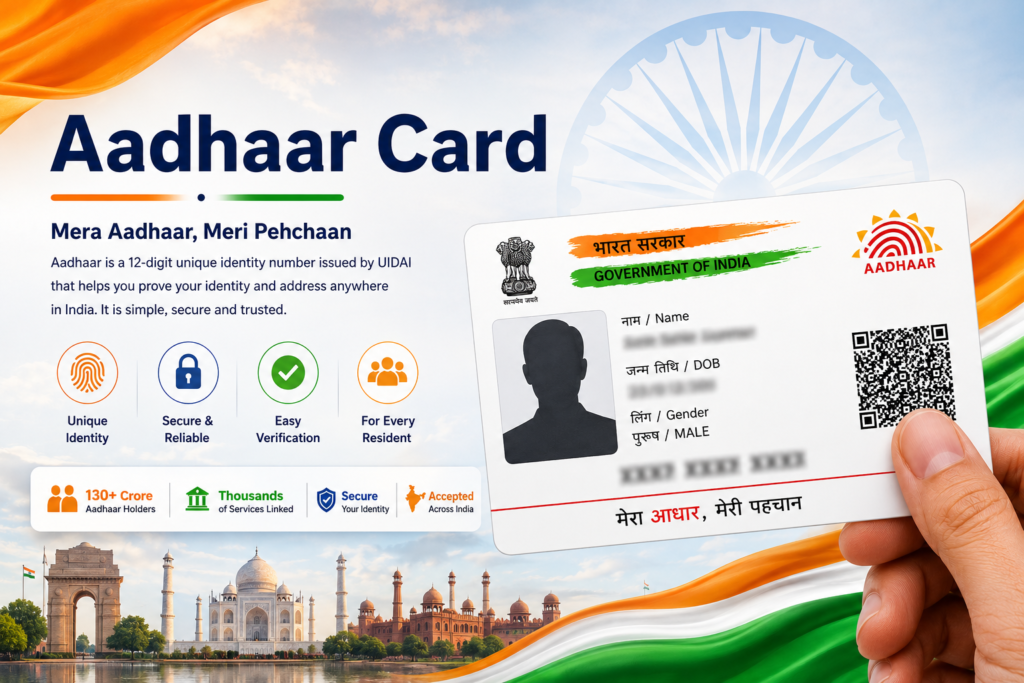
The Aadhaar card is one of the most important identity documents issued to residents of India. It contains a 12-digit unique identification number that is generated and managed by the Unique Identification Authority of India (UIDAI). This number is linked with a person’s biometric and demographic details, making Aadhaar one of the most reliable identity systems in the country.
In this guide, you will learn everything about Aadhaar card services including how to download Aadhaar, update Aadhaar details, check Aadhaar status, order PVC Aadhaar card, and use various UIDAI online services.
What we find on this page:
1 What is Aadhaar Card
2 History and Purpose of Aadhaar
3 Importance of Aadhaar Card in India
4 Services Available Online
5 Download Aadhaar Card Online
6 Aadhaar PDF Password Format
7 How to Check Aadhaar Card Status
8 How to Update Aadhaar Details
9 Aadhaar Address Update
10 Aadhaar Mobile Number Update
11 PVC Aadhaar Card
12 Virtual ID (VID)
13 Lock or Unlock Aadhaar Biometrics
What is Aadhaar Card
Aadhaar is a unique identification system that assigns a 12-digit number to residents of India after verifying their biometric and demographic information. This number acts as a digital identity that can be used for authentication across multiple services.
Unlike many traditional identity documents, Aadhaar is linked with biometric data such as fingerprints and iris scans. This biometric linkage ensures that each Aadhaar number is unique and cannot be duplicated.
The Aadhaar number is valid for a lifetime and can be used for both online authentication and offline verification.
Key characteristics of Aadhaar include:
- Unique 12-digit identification number
- Biometric and demographic verification
- Valid across India
- Lifetime validity
- Secure digital authentication
Because of these features, Aadhaar has become a reliable identity platform for residents across the country.
History and Purpose of Aadhaar
The Aadhaar program was launched by the Government of India with the objective of providing a single, universal identity system for residents. Before Aadhaar, individuals often had to submit multiple identity documents for different services.
The introduction of Aadhaar helped simplify identity verification. The system was designed to ensure that every resident receives a unique identification number that can be verified electronically.
One of the main purposes of Aadhaar is to improve the delivery of government subsidies and welfare schemes. By linking beneficiaries with Aadhaar, the government can ensure that benefits reach the intended individuals directly.
This approach has helped reduce fraud and duplication in various public distribution and welfare programs.
Importance of Aadhaar Card in India
Aadhaar has become an essential document in everyday life for many residents. It is widely accepted as proof of identity and address and is often required for various financial and government services.
Some of the most common uses of Aadhaar include:
Identity Verification
Aadhaar serves as a valid proof of identity and address for many official purposes.
Government Schemes
Many welfare programs require Aadhaar authentication to ensure that subsidies reach the correct beneficiaries.
Banking Services
Banks use Aadhaar for KYC verification when opening accounts or providing financial services.
Income Tax and PAN Linking
Aadhaar is often used for linking with PAN while filing income tax returns.
Mobile and Telecom Services
Telecom companies may use Aadhaar authentication to verify the identity of customers.
Digital Authentication
Aadhaar enables secure authentication for many online services.
Because of these uses, it is important for residents to maintain accurate and updated Aadhaar information.
Aadhaar Services Available Online
UIDAI provides several Aadhaar services through its online portal, allowing residents to manage many Aadhaar-related tasks from home.
Some of the most commonly used Aadhaar services include:
- Download Aadhaar card
- Check Aadhaar card status
- Update Aadhaar details
- Update Aadhaar address online
- Order PVC Aadhaar card
- Lock or unlock Aadhaar biometrics
- Generate Aadhaar Virtual ID
- Locate Aadhaar enrollment centres
These services make Aadhaar management more convenient and reduce the need for frequent visits to Aadhaar centres.
How to Download Aadhaar Card Online
Residents who have already enrolled for Aadhaar can easily download the digital version known as e-Aadhaar from the UIDAI portal.
e-Aadhaar is the electronic copy of the Aadhaar card and is considered valid for all official purposes.
Steps to Download Aadhaar Card
- Visit the official UIDAI website.
- Open the Download Aadhaar section.
- Enter your Aadhaar number, Enrollment ID, or Virtual ID.
- Enter the security code shown on the screen.
- Verify the request using the OTP sent to your registered mobile number.
- Download the Aadhaar PDF file.
The downloaded file is password protected to ensure privacy and security.
Aadhaar PDF Password Format
The Aadhaar PDF file requires a password to open.
The password format is:
First four letters of your name in capital letters + birth year
Example:
Name: Rahul Kumar
Year of Birth: 1990
Password: RAHU1990
This security mechanism protects the downloaded Aadhaar file from unauthorized access.
How to Check Aadhaar Card Status
After enrolling for Aadhaar or requesting an update, you may want to check the status of your Aadhaar card.
UIDAI provides an online facility to track the progress of Aadhaar enrollment or update requests.
Steps to Check Aadhaar Status
- Visit the UIDAI website.
- Navigate to the Check Aadhaar Status section.
- Enter your Enrollment ID or Update Request Number.
- Enter the captcha code.
- Submit the form to view your Aadhaar status.
The system will show whether your Aadhaar has been generated, updated, or dispatched.
How to Update Aadhaar Details
It is important to keep Aadhaar details accurate so that authentication processes work correctly.
UIDAI allows residents to update certain information in their Aadhaar record when needed.
Some of the details that can be updated include:
- Address
- Mobile number
- Name
- Date of birth
- Photograph
- Biometric information
Certain updates can be completed online, while others require visiting an Aadhaar enrollment centre.
Aadhaar Address Update
Residents who move to a new location may need to update their address in Aadhaar records.
UIDAI allows address updates through the online portal.
Steps for Address Update
- Log in to the Aadhaar online portal.
- Select the Address Update option.
- Enter the new address details.
- Upload valid address proof documents.
- Submit the request.
After submission, an update request number is generated which can be used to track the update status.
Aadhaar Mobile Number Update
Your mobile number is important for Aadhaar services because OTP verification is required for many transactions.
If your mobile number changes, you need to update it in Aadhaar records.
Process for Mobile Number Update
- Visit the nearest Aadhaar enrollment centre.
- Fill out the Aadhaar update form.
- Provide your Aadhaar number.
- Complete biometric verification.
- Submit the request and receive a receipt.
You can later track the update request using the provided reference number.
Order PVC Aadhaar Card
UIDAI offers the option to order a PVC Aadhaar card, which is a durable and convenient version of the Aadhaar card.
The PVC Aadhaar card is designed to be easy to carry and includes multiple security features.
Features of PVC Aadhaar:-
- Secure QR code
- Hologram
- Micro text printing
- Embossed Aadhaar logo
- Durable PVC material
Residents can order this card online through the UIDAI portal and receive it by post.
Aadhaar Virtual ID (VID)
The Aadhaar Virtual ID is a temporary 16-digit number that can be used instead of the Aadhaar number for authentication.
The main objective of VID is to enhance privacy and protect the Aadhaar number from unnecessary sharing.
Key features include:-
- Can be generated online
- Can be regenerated multiple times
- Used for Aadhaar authentication
Using VID provides an additional layer of privacy protection.
Lock or Unlock Aadhaar Biometrics
UIDAI provides a feature that allows users to lock their biometric information to prevent misuse.
Benefits of Biometric Lock
- Protects fingerprint and iris data
- Prevents unauthorized authentication
- Can be unlocked whenever needed
Residents can lock or unlock biometrics through the UIDAI website or the mAadhaar mobile application.
Aadhaar Enrollment and Seva Kendras
For services that cannot be completed online, residents can visit Aadhaar Seva Kendras or Aadhaar Enrollment Centres.
These centres provide services such as:-
- Aadhaar enrollment
- biometric updates
- mobile number update
- demographic updates
- document verification
UIDAI also provides an online tool to locate the nearest Aadhaar centre.
Aadhaar Benefits: Advantages of Aadhaar Card for Residents in India
The Aadhaar card has become one of the most widely used identity documents in India. Issued by the Unique Identification Authority of India (UIDAI), Aadhaar provides a unique 12-digit identification number to every resident. This number is linked with biometric and demographic details, making it a reliable system for identity verification.
Since its introduction, Aadhaar has been integrated into many government services, financial systems, and digital platforms. It allows individuals to prove their identity quickly and helps ensure that government benefits reach the correct beneficiaries.
Aadhaar also supports several digital services that make it easier for residents to access banking, welfare schemes, and online verification systems.
This guide explains the major benefits of Aadhaar, how it helps individuals access services, and why it has become an important part of India’s digital identity infrastructure.
Key Benefits of Aadhaar Card
Aadhaar offers several advantages that make it useful for individuals as well as government institutions.
Universal Identity Proof
One of the most important benefits of Aadhaar is that it serves as a widely accepted identity document across India.
The Aadhaar card can be used as proof of identity and address for various services including banking, telecom verification, and government programs.
Since Aadhaar is recognized nationwide, residents do not need multiple identity documents for different services.
Access to Government Welfare Schemes
Aadhaar helps ensure that government welfare benefits reach the correct beneficiaries.
Many government programs use Aadhaar authentication to verify the identity of individuals before providing benefits.
Examples of government schemes linked with Aadhaar include:
- LPG subsidy programs
- Pension schemes
- Scholarship programs
- Public Distribution System (ration cards)
Aadhaar linking helps prevent fraud and ensures that benefits are delivered to eligible individuals.
Direct Benefit Transfer (DBT)
The Direct Benefit Transfer system is one of the most important advantages of Aadhaar.
Under DBT, government subsidies and welfare payments are transferred directly to the bank accounts of beneficiaries.
By linking Aadhaar with the bank account, the government can transfer funds without intermediaries.
This system improves transparency and reduces the risk of corruption or delays in payments.
Simplified Banking Services
Aadhaar has made it easier for individuals to access banking services. Banks can verify the identity of customers using Aadhaar authentication, which simplifies the process of opening new accounts. Many banks allow Aadhaar-based electronic KYC (e-KYC) verification, which allows customers to open accounts quickly without extensive paperwork. Aadhaar also helps verify customer identity during financial transactions.
Easy Income Tax Filing
Aadhaar plays an important role in income tax services in India. Linking Aadhaar with PAN helps verify the identity of taxpayers and prevents individuals from using multiple PAN numbers. Taxpayers can also verify their income tax returns using Aadhaar OTP authentication, which simplifies the verification process. This makes income tax filing more efficient and secure.
Digital Identity for Online Services
Aadhaar provides a digital identity that can be used for various online services. Through Aadhaar authentication, individuals can verify their identity on digital platforms quickly. Many services use Aadhaar-based verification including:
- Online government services
- Financial service platforms
- Digital payment systems
- Insurance services
This digital identity helps make online services more secure and convenient.
Access to Financial Inclusion Programs
Aadhaar has helped improve financial inclusion in India. Many individuals who previously did not have access to banking services can now open bank accounts using Aadhaar verification. Programs such as the Pradhan Mantri Jan Dhan Yojana use Aadhaar to help people open zero-balance bank accounts. This allows individuals to access financial services such as savings accounts, insurance, and pension schemes.
Simplified Mobile SIM Verification
Telecommunication companies use Aadhaar authentication to verify the identity of mobile subscribers. Aadhaar-based verification helps telecom providers confirm customer identity quickly. This process helps prevent misuse of mobile connections and ensures that SIM cards are issued to verified individuals.
Secure Authentication System
The Aadhaar system uses advanced authentication methods to verify identity. These include:
- Biometric authentication (fingerprint or iris scan)
- OTP authentication through registered mobile numbers
- Virtual ID verification
These security features help protect personal information and ensure safe identity verification.
Portable Identity Across India
Another important benefit of Aadhaar is portability. Since Aadhaar is recognized nationwide, residents can use the same identity document anywhere in India. This is especially useful for individuals who move to different states for employment, education, or other purposes. Aadhaar allows them to access services without needing new identity documents.
Aadhaar Benefits for Children
Children can also receive Aadhaar numbers through the Baal Aadhaar program. This allows children to access government services such as education programs, scholarships, and healthcare services. Parents can enroll their children for Aadhaar at enrollment centers. Biometric information is updated when the child grows older.
Aadhaar for Digital Governance
Aadhaar supports digital governance initiatives across India. Government departments use Aadhaar authentication to provide services online. This allows citizens to access services without visiting government offices. Digital verification through Aadhaar improves efficiency and reduces paperwork in government systems.
Transparency in Public Services
Aadhaar helps improve transparency in public services. By verifying the identity of beneficiaries, the government can reduce duplicate records and fraudulent claims. This helps ensure that public funds are used effectively and reach the intended recipients.
Common Concerns About Aadhaar
Some individuals may have concerns about Aadhaar usage and privacy. To address these concerns, UIDAI has introduced several security measures. Residents can:
- Lock their biometric data
- Use Aadhaar Virtual ID instead of the actual Aadhaar number
- Monitor authentication history
These features allow individuals to control how their Aadhaar information is used.
Common Aadhaar Services Overview
| Service | Mode |
| Download Aadhaar | Online |
| Check Aadhaar Status | Online |
| Address Update | Online |
| Mobile Number Update | Aadhaar Center |
| Name Correction | Online / Center |
| Biometric Update | Aadhaar Center |
| Order PVC Aadhaar | Online |
Frequently Asked Questions
Q. Is e-Aadhaar valid as the original Aadhaar card
Yes. e-Aadhaar is digitally signed by UIDAI and is considered valid as the physical Aadhaar card.
Q. Can Aadhaar details be updated online
Certain details such as address can be updated online, while biometric updates require visiting an Aadhaar centre.
Q. What is Aadhaar Virtual ID
Aadhaar Virtual ID is a temporary identification number used instead of the Aadhaar number for authentication.
Is Aadhaar mandatory for all services
Aadhaar is widely used for many services, but the requirement depends on the specific service or scheme.
Conclusion
The Aadhaar card has become a central part of India’s identity and digital authentication ecosystem. With its biometric verification system and secure digital framework, Aadhaar provides a reliable method for identity verification across various sectors. UIDAI has made Aadhaar services more accessible by offering multiple online facilities, allowing residents to download Aadhaar, update personal details, check status, and order PVC Aadhaar cards conveniently. By keeping Aadhaar information accurate and using security features such as biometric lock and Virtual ID, residents can safely manage their digital identity and access various services with ease.